


As a supplier of automatic blanking machines, I am often asked about the technical specifications of these remarkable pieces of equipment. In this blog post, I will delve into the key technical aspects of automatic blanking machines, providing you with a comprehensive understanding of what makes them so efficient and reliable in various industrial applications.
1. Working Principle
Automatic blanking machines operate based on a well - defined working principle. They are designed to cut or punch materials into specific shapes and sizes with high precision. The basic process involves feeding the raw material, usually a sheet or coil of metal, plastic, or other materials, into the machine. The machine then uses a die to cut or punch the material according to the pre - set pattern.
For example, in the case of metal blanking, the machine applies a high - pressure force to the die, which shears the metal sheet along the desired shape. This process is highly automated, reducing the need for manual labor and increasing the production speed. The control system of the automatic blanking machine ensures that the cutting or punching operations are carried out accurately and consistently.
2. Cutting Force
One of the most important technical specifications of an automatic blanking machine is its cutting force. The cutting force is measured in tons and determines the machine's ability to cut through different thicknesses and types of materials.
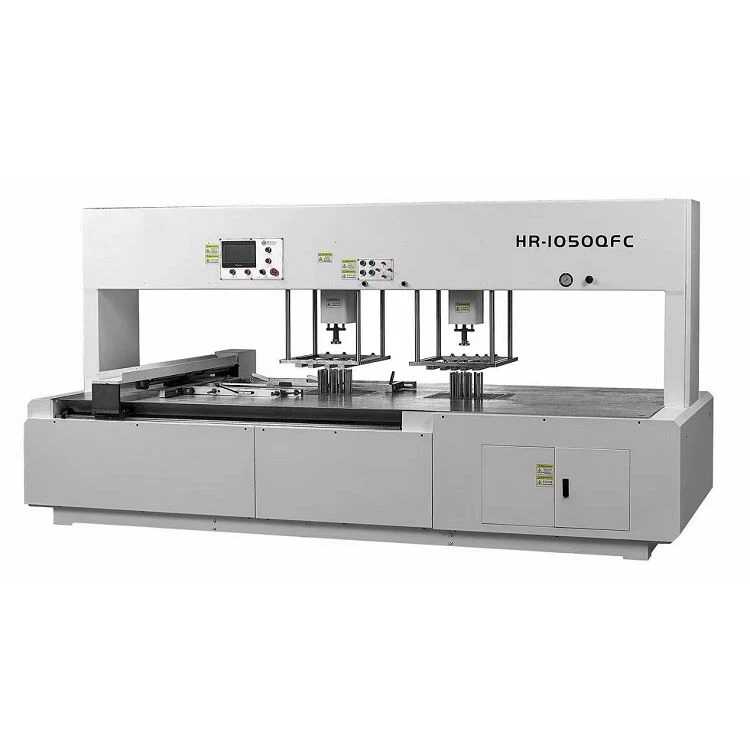
For thinner materials such as aluminum foils or thin plastic sheets, a lower cutting force may be sufficient. However, when dealing with thick steel plates, a high - capacity machine with a large cutting force is required. Our HR - 1050QFC Automatic Blanking Machine is designed to handle a wide range of materials with a cutting force that can be adjusted according to the specific requirements of the job. This flexibility allows for efficient processing of different materials, from soft plastics to hard metals.
3. Die Size and Compatibility
The die size is another crucial factor. The die is the tool that shapes the material during the blanking process. Automatic blanking machines support different die sizes, and the choice of die size depends on the size and shape of the final product.
Some machines are designed to accommodate a variety of die sizes, providing greater versatility. Our HR - 1050QF Automatic Blanking Machine offers excellent die compatibility. It can be easily fitted with different dies, allowing for the production of various products, from small components to large - scale parts. This adaptability makes it a popular choice among manufacturers who need to produce a diverse range of products.
4. Feed System
The feed system of an automatic blanking machine is responsible for moving the raw material into the cutting or punching area. There are different types of feed systems, including roller feeds, servo feeds, and gripper feeds.
Roller feeds are simple and cost - effective, suitable for basic applications. Servo feeds, on the other hand, offer higher precision and can be programmed to feed the material at different speeds and lengths. Gripper feeds are often used for high - speed applications where accurate positioning of the material is crucial. Our automatic blanking machines are equipped with advanced servo feed systems, which ensure precise and consistent feeding of the material, resulting in high - quality finished products.
5. Control System
The control system is the brain of the automatic blanking machine. It controls all the operations of the machine, including the cutting force, feed speed, and die movement. A modern control system allows for easy programming and operation.
Most of our machines are equipped with a user - friendly touch - screen control panel. Operators can input the required parameters such as cutting length, number of cuts, and feed speed with just a few touches. The control system also provides real - time monitoring of the machine's performance, allowing operators to detect and solve any potential problems quickly. Additionally, it can store multiple programs, making it convenient to switch between different production tasks.
6. Production Speed
Production speed is a significant consideration for manufacturers. Automatic blanking machines are designed to achieve high production speeds while maintaining accuracy. The production speed is usually measured in strokes per minute (SPM).
The speed of the machine depends on several factors, including the cutting force, die size, and the type of material being processed. Our machines are engineered to provide a high SPM, ensuring efficient mass production. For example, in certain applications, our machines can achieve up to 200 SPM, significantly increasing the productivity of the manufacturing process.
7. Accuracy and Repeatability
Accuracy and repeatability are essential in the manufacturing industry. An automatic blanking machine should be able to cut or punch materials with high precision and produce identical parts consistently.
The accuracy of our machines is measured in millimeters or inches, and we ensure that our machines can achieve an accuracy of up to ±0.1 mm. This high level of accuracy is achieved through the use of advanced mechanical components and precise control systems. Repeatability is also guaranteed, meaning that the machine can produce the same part with the same dimensions over and over again. This is crucial for industries such as automotive and aerospace, where parts need to meet strict quality standards.
8. Safety Features
Safety is of utmost importance in any industrial setting. Automatic blanking machines are equipped with a range of safety features to protect operators and prevent accidents.
These features include emergency stop buttons, safety guards, and light curtains. The emergency stop button allows operators to immediately stop the machine in case of an emergency. Safety guards prevent operators from coming into contact with moving parts, while light curtains detect any intrusion into the dangerous area and stop the machine automatically. Our machines comply with all relevant safety standards, providing a safe working environment for operators.

9. Maintenance Requirements
Proper maintenance is essential to ensure the long - term performance and reliability of an automatic blanking machine. Regular maintenance includes lubrication of moving parts, inspection of electrical components, and replacement of worn - out parts.
Our machines are designed for easy maintenance. They have accessible maintenance points, and the user manual provides detailed instructions on how to perform routine maintenance tasks. We also offer after - sales support, including maintenance training and spare parts supply, to help our customers keep their machines in optimal condition.
Conclusion
In conclusion, automatic blanking machines are complex and highly efficient pieces of equipment. Their technical specifications, including cutting force, die size, feed system, control system, production speed, accuracy, safety features, and maintenance requirements, all play a crucial role in their performance.
If you are in the market for an automatic blanking machine, I encourage you to consider our products. Our HR - 1050QFC Automatic Blanking Machine and HR - 1050QF Automatic Blanking Machine offer a combination of high - performance features, reliability, and ease of use. Whether you are a small - scale manufacturer or a large - scale industrial enterprise, we have the right solution for your blanking needs.
Contact us today to discuss your specific requirements and start a procurement negotiation. We are committed to providing you with the best products and services to help you achieve your production goals.
References
- Industry standards and guidelines for automatic blanking machines.
- Technical documentation of our automatic blanking machines.
- Research papers on the development and application of automatic blanking technology.


