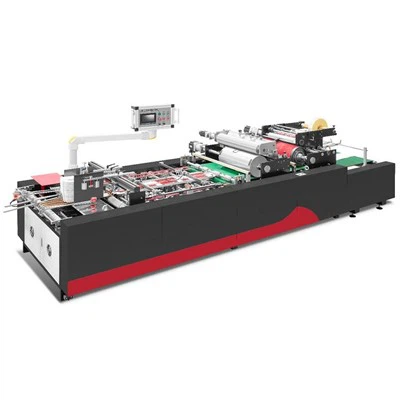
Hey there! As a supplier of Fully Automatic Laminating Machines, I've seen firsthand how crucial it is to ensure the uniformity of lamination. In this blog post, I'm gonna share some tips on how you can achieve that.
Understanding the Basics of Lamination
Before we dive into the details, let's quickly go over what lamination is all about. Lamination is the process of bonding two or more materials together using an adhesive. In the case of a fully automatic laminating machine, this usually involves sticking a film or a sheet onto a substrate, like paper or cardboard.
The key to achieving uniform lamination is to make sure that the adhesive is evenly applied, and the pressure and temperature are consistent throughout the process. Any variation in these factors can lead to uneven lamination, which can affect the quality of the final product.


Pre - machine Preparation
Material Inspection
First things first, you gotta inspect your materials. The substrate and the laminating film should be free from any defects, such as wrinkles, scratches, or dirt. Even a small imperfection can disrupt the lamination process and cause uneven bonding. For example, if the substrate has a wrinkle, the adhesive might not spread evenly over that area, resulting in a weak bond.
Adhesive Selection
Choosing the right adhesive is super important. Different materials require different types of adhesives. You need to consider factors like the bonding strength, drying time, and compatibility with the substrate and the laminating film. For instance, if you're laminating a porous material like paper, you'll need an adhesive that can penetrate the pores and create a strong bond. On the other hand, if you're working with a non - porous material like plastic, a different type of adhesive might be more suitable.
Machine Settings
Temperature Control
Temperature plays a huge role in lamination. The adhesive needs to be heated to a specific temperature to become sticky and bond the materials together. If the temperature is too low, the adhesive won't be able to flow properly, and the lamination will be weak. If it's too high, the adhesive might burn or the materials could get damaged.
Most fully automatic laminating machines have temperature controls. You should set the temperature according to the specifications of the adhesive and the materials you're using. For example, some adhesives work best at around 100 - 120 degrees Celsius, while others might require a higher or lower temperature.
Pressure Adjustment
Pressure is another critical factor. The machine needs to apply enough pressure to ensure that the adhesive spreads evenly and the materials are firmly bonded together. However, too much pressure can cause the materials to deform or the adhesive to squeeze out from the edges.
You can adjust the pressure settings on the machine. Start with a low pressure and gradually increase it until you achieve the desired lamination quality. You can test the pressure by laminating a small sample and checking for any signs of uneven bonding or material damage.
Speed Regulation
The speed at which the materials pass through the laminating machine also affects the uniformity of lamination. If the speed is too fast, the adhesive might not have enough time to bond properly. If it's too slow, it can lead to over - heating and other issues.
You should set the speed based on the type of materials, the adhesive, and the machine's capabilities. Generally, a slower speed is better for thicker materials or adhesives that take longer to dry.
In - process Monitoring
Visual Inspection
During the lamination process, you should regularly inspect the laminated materials. Look for any signs of uneven lamination, such as bubbles, wrinkles, or areas where the adhesive hasn't spread properly. If you notice any issues, you can make adjustments to the machine settings immediately.
Quality Checks
You can also perform some simple quality checks. For example, you can try to peel the laminating film off the substrate gently. If the film comes off easily or in patches, it means the lamination is not uniform. You can also measure the thickness of the laminated materials at different points to ensure that it's consistent.
Maintenance and Calibration
Regular Cleaning
A clean machine is essential for uniform lamination. Over time, dust, debris, and adhesive residue can build up on the machine's rollers, belts, and other components. This can affect the pressure distribution and the flow of the adhesive, leading to uneven lamination.
You should clean the machine regularly according to the manufacturer's instructions. Use appropriate cleaning agents and tools to remove any dirt or residue.
Calibration
Periodically calibrating the machine is also important. This ensures that the temperature, pressure, and speed settings are accurate. You can use calibration tools or follow the calibration procedures provided by the manufacturer.
Our Products and Solutions
At our company, we offer a range of Fully Automatic Laminating Machines that are designed to provide uniform lamination. Our machines are equipped with advanced temperature, pressure, and speed control systems, which allow for precise adjustments.
One of our popular models is the HW - 1200 Flute Laminating Machine. This machine is specifically designed for laminating corrugated cardboard. It has a high - precision pressure system that ensures even bonding across the entire surface of the cardboard.
If you're looking for a reliable solution to your lamination needs, we'd love to hear from you. Whether you're a small business or a large - scale manufacturer, we can provide you with the right machine and support to achieve uniform lamination.
Conclusion
Ensuring the uniformity of lamination in a fully automatic laminating machine requires a combination of proper pre - machine preparation, accurate machine settings, in - process monitoring, and regular maintenance. By following these tips and using high - quality machines like ours, you can achieve consistent and high - quality lamination results.
If you have any questions or are interested in purchasing one of our Fully Automatic Laminating Machines, feel free to reach out to us. We're here to help you take your lamination process to the next level.
References
- Smith, J. (2020). "Advanced Lamination Techniques". Lamination Journal.
- Brown, A. (2019). "Optimizing Lamination Quality in Automatic Machines". Manufacturing Insights.